

#36: The Sealed Soil
The first surviving feature film directed by an Iranian women explores the tension between documentary and fiction within a thematic framework of subtle rebellion
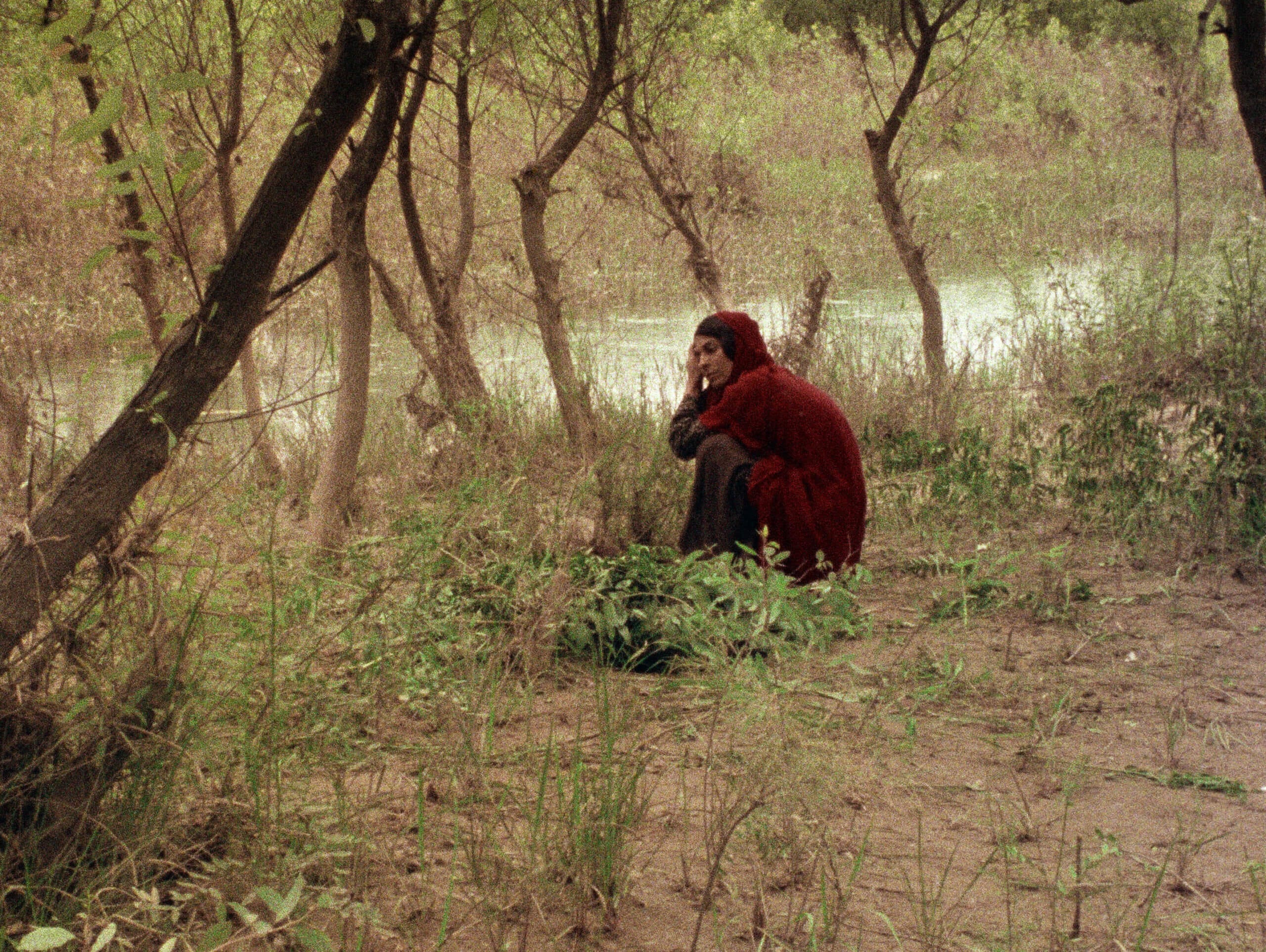
Marva Nabili’s The Sealed Soil, the earliest surviving film directed by an Iranian woman, begins with a quote from Albert Camus’ The Rebel: “But before man accepts the sacred world and in order that he should be able to accept it – or before he escapes from it and in order that he should be able to escape from it – there is always a period of soul-searching and rebellion.” By “sacred world,” Camus is not referring to a purely spiritual metaphysical universe, but rather a pre-existing world of inherited values that a specific society imposes on individuals. Camus elaborates on the above passage by describing the sacred world as a realm in which people are expected to accept the meaning that’s been laid out for them and the roles that have been given to them. While the connection between these ideas and The Sealed Soil’s narrative seems slightly uncertain for much of the first half of the film, Nabili slowly unspools a fable of rebellion that is punctuated by alternately violent and sensual moments that rupture the ethnographic surface of the film. The recent 4K restoration of the film led by the UCLA archive has led to a string of screenings for this exceptional film. Thanks to the efforts of film archivists, preservationists, curators and distributors, the film is now available to stream on Criterion Channel after having been unavailable for many years.
At the start of The Sealed Soil, we are introduced to the protagonist, Rooy-Bekheir, an 18-year old girl played by Flora Shabaviz. Nabili composes the shot so that Rooy-Bekheir is on one side of the frame and a couple of colorful blankets adorn the rest of the frame. We surmise that a few of the blankets may belong to people that Rooy-Bekheir lives with. But initially we see Rooy-Bekheir alone, braiding her long hair and placing a shawl over her head. This moment of solitude establishes a sense of privacy that in retrospect turns out to be brief respite in a domestic life characterized by a near-constant presence of family members, villagers and farm animals. At one point, Rooy-Bekheir says that she wants to go to the field to farm for grains, leading her mother to respond that a woman of her age should spend most of her time at home to field potential suitors. This moment establishes the predominant social pressure that Rooy-Bekheir faces as she is informed of the male suitors that are proposed to her as marriage candidates. Conversations surrounding the topic of suitors inevitably involve details surrounding the dowry and other goods that will be offered as payment in the transaction of the arranged marriage. Through implication, we come to learn that Rooy-Bekheir is uninterested and even flatly hostile to the idea of meeting these suitors The other social pressure that Nabili introduces involves the announcement by the village’s chief that an agribusiness company is offering money so that the residents can move to a new settlement that the Shah of Iran has developed nearby. Money plays a large role in both the marriage and shelter issues.
These social/economic pressures are presented less as narratives and more as looming shadows that exist at the edges of the frame, threatening to break through the placidity of the surface film. As the film progresses, we slowly see Rooy-Bekheir mentally unravel as the strain of living under judgement, gossip and implied economic strain wears on her. But through much of the early half of the film, we are not really privy to Rooy-Bekheir’s internal tumult. Most of the film’s early scenes show women performing domestic duties in the space just outside the mud huts that comprise the small village. We see the women of the village sift through grains, heat water for cooking and sort through the crops they’ve collected as chickens wander in and out of Nabili’s long takes. The men seem not to partake in most of the domestic duties that the women carry out. In the scene in which the chief of the village discusses the agribusiness’s resettlement offer, the only villagers involved in the conversation are men.
In addition to showing the gendered division of roles, Nabili also indicates that the adult women of the school have been deprived of educational opportunity. Early in the film, Nabili shows Rooy-Bekheir as she carries a water jug balanced on her head and walks through an archway in a shot that recurs at several points during the film. Nabili then cuts to a point-of-view shot from Rooy-Bekheir’s perspective that shows child students walking past what appears to be a train crossing point. The students are attending a school that was established relatively recently in the aforementioned settlement. One implication of this shot-reverse-shot is that Rooy-Bekheir is seeing the young children have an experience with formal schooling that she never had. As something of a counterpoint, Rooy-Bekheir’s younger sister appears to be going to that school and her mother makes multiple critiques of the teacher’s seemingly untraditional recommendations about dress and grooming. Through the presentation of these social details, Nabili presents a vivid depiction of a society in an awkward transition toward modernity.
Nabili’s approach is to establish a routine for both Rooy-Bekheir’s day-to-day life and the functioning of the village, and then deploy formal shifts to signal Rooy-Bekheir’s unstable emotional trajectory. Early shots of the village present a tableau of persistent movement, with villagers exiting and entering the doors of the mud huts that are often in frame. Minor indications of discord arise occasionally, but on the whole the village is presented as an efficiently functioning unit. As the film progresses, we slowly begin to see that Rooy-Bekheir is not fully conforming to the expectations placed on her. In one scene at a well in the new settlement, Rooy-Bekheir’s sister tells some fellow villagers that she’s there because Rooy-Bekheir prefers not to go to the settlement, thus hinting at Rooy-Bekheir’s possible animus toward the settlement. In the next scene, we see Rooy-Bekheir learning to read near a large pot framed to the left of a chicken in a nest in a hole in the wall outside the room. A woman calls out her name twice, leading Rooy-Bekheir’s to quickly hide the book. This startled reaction indicates that Rooy-Bekheir might not want others to know that she’s reading while she should be tending to her duties. The woman who called out for Rooy-Bekheir asks for beans from the pot and informs her that a male suitor will be visiting her soon. Nabili then cuts to a shot of Rooy-Bekheir kneeling just outside of the room with the pot. In a flash of anger, Rooy-Bekheir lunges at the chicken in the nest, causing it to fly away. Rooy-Bekheir then grabs a shawl and wraps it around her in a boldly defiant manner. This action foreshadows Rooy-Bekhir’s broader acts of rebellion against social norms and her eventual nervous breakdown. But in addition to these psychological aspects, the action functions as a rebellion against the ethnographic form of the surface film. The chicken, which we as the audience might view as an emblem of the film’s documentary realism, becomes for Rooy-Bekheir a symbol of her oppression.
Nabili uses formal devices like shorter takes, sensual longueurs in nature, dissonant music and closer shots to signal the film’s progression from the communal to the individual. We then return to the community engulfing the individual as the villagers escort Rooy-Bekheir to the shrine where a local mullah performs an exorcism on her. Flora Shabaviz (who plays Rooy-Bekheir) is credited as the only professional actress in the film; the other characters are played by real-life residents of the village. This makes sense, as a big part of the film’s impact comes from the turn that Shabaviz’s performance takes toward a more demonstrative style. The clash between Shabaviz’s increasingly stylized performance and the more naturalistic depiction of the rest of the community becomes a central aesthetic strategy.
Nabili has said in interviews that she tried to portray the villagers going about their routines as they would if there were no cameras around. It is unclear how much of the dialogue was scripted vs. how much was improvised, but one drawback of Nabili’s approach of structured realism is that some of the dialogue announces the film’s themes a bit directly. However, this might be more a feature than a bug. To my mind, Nabili isn’t necessarily seeking to replicate the texture and rhythms of everyday discussion. Rather, she is creating a social context through which we can observe Rooy-Bekhir and contemplate her mysterious interaction with the world around her. At the film’s end, the issue of marriage hasn’t gone away and we don’t know whether she and her family have decided to move to the new settlement. It is unclear whether Rooy-Bekheir is choosing to embrace or escape the sacred world that she has been born into. But the last shot hints at the possibility of change: Nabilii employs a shot of the train crossing that replicates the earlier point of view shot from Rooy-Bekheir’s perspective. For the first time, Rooy-Bekheir enters the frame and walks toward the new settlement. It is to the film’s credit that the final shot can be read alternately as a signal of a life-altering decision or as a depiction of our protagonist simply walking to the well to collect water.