

#38: Ella McCay
James L. Brooks' latest is a refreshing dose of sincerity within a wave of studio cynicism
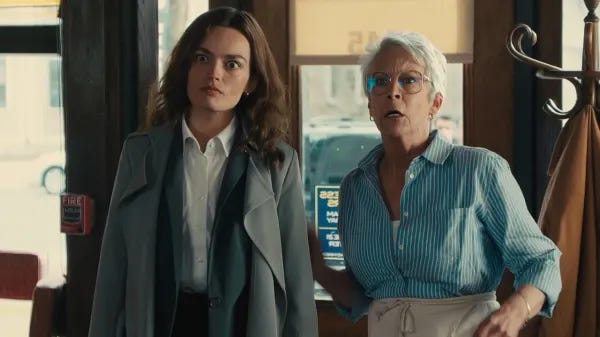
It is a shame that Disney/20th Century Studios/Fox/whatever they’re called now, might come away from the experience of funding James L. Brooks’ new film with some regret. After the film’s $2.1 million opening weekend, it seems that online periodicals are rushing en masse to deem Ella McCay a boxoffice failure. I will spare you my thoughts about The State of the Industry post-Warner Brothers/Netflix acquisition, but I can’t exactly see a near future where the kind of modern studio comedies that I enjoy (Aloha, Downsizing, Brooks’ own How Do You Know) will have much broad commercial success. That’s not a huge tragedy, as it’s not particularly important whether studios are catering directly to my tastes. But in the bigger picture of commercial cinema at large, Ella McCay’s box-office failure does not bode well for an industry that is becoming increasingly loath to take risks on middle budget films from directors with a unique sensibility.
All that to say, I really enjoyed Ella McCay and am grateful that I came away from a pretty bleak run of studio releases this year with at least one film to champion. I get the impression that Ella McCay has become an object of derision, perhaps because of James L. Brooks’ brand of painfully sincere/on the verge of overly-sentimental filmmaking in which characters hyper-articulately lay out their intimate thoughts and say endearingly (or cloyingly, if you’re not on the wavelength) oddball things. But I just find it refreshing to see a film that uses a genre framework to deal with some of the familial and professional problems that real people face. Now, I know the rejoinder to my argument might be that Ella McCay is not a woman who would exist in a real-world political landscape and the problems that she deals with are movie problems and not real people problems. For me, that’s beside the point. The film’s effect does not come primarily from its connection to real-world political/social/cultural experiences (the film is deliberately nebulous in its sense of time and place, being set in an unspecified state in 2008). Rather, in the tradition of satirists like Preston Sturges, Brooks establishes a farcical foundation for his films which he plays against with surprising realist elements.
The film gets off to a bit of a clunky start in a flashback with the introduction of Ella McCay’s father Eddie (Woody Harrelson) who makes a strangely formal speech to his family about his extramarital affairs. In general, I find the thread surrounding Harrelson to be the least successful in the film, but one could consider it a necessary evil to establish the kind of screwball tone that Brooks is going for. Personal matters that might otherwise be discussed behind closed doors are brought out into the open and Brooks presents the proceedings as something of a battle between father and daughter for authority over the narrative of the situation. Before confronting her father about his philandering, Ella (Emma Mackey) first sends her little brother to the kitchen to get water so he won’t have to hear the tawdry details. The conversation becomes explicitly sexual, so when the brother returns, Ella tells him to put some ice in the water, to which the brother replies with a simple and hilarious “no.” Just as in the great screwball comedies of the old Hollywood era, the chaos wrought by offscreen sexual activity intrudes into the quotidian, leading to some wacky complications as characters struggle to gain a foothold in the aftermath.
The interjection of the brute fact of sex into an otherwise wholesome humanist comedy is a recurring element of the film. During another flashback later in the film, Ella’s Aunt Helen (Jamie Lee Curtis) sees Ella’s high school sweetheart and future husband Ryan (Jack Lowden) jumping from Ella’s second story bedroom after spending the night. When Helen goes to confront Ella about this, she does not categorically deny that she had sex, but instead gives precisely-crafted evasive answers to Helen’s questions (it makes sense that she grows up to become a politician). Then as Ella walks out the door, Helen blurts out to ask if her partner used a “johnny,” leading Ella to ask what she means, after which Helen clarifies that she’s referring to a condom. Helen screams out the word “condom” as Ella walks past a neighbor whom she makes awkward eye contact with. Part of what makes the scene so funny is that Helen’s internal struggle over whether to chastise or nurture manifests itself in some believably tentative and quirky lines of dialogue.
The loving but often fractious exchanges between Ella and her Aunt Helen best reflect Brooks’ penchant for writing hyper-articulate characters who still somehow struggle to communicate. We see this in Helen’s frequent attempts to show Ella that she does not think Ryan is the right man for him. It’s not so much that Ella does not harbor doubts about Ryan (these soon become apparent), but rather that Ella will always find a pragmatic way to avoid getting into an uncomfortable conversation with her aunt. While you would generally consider Ella to be a sincere and responsible woman, she seems like the kind of person who will go to great lengths to avoid dealing with the messiness of personal and familial matters. In another establishing scene between Eddie and the now-adult Ella, the conversation between father and daughter quickly devolves as Ella identifies some of her father’s moral failures. There is an abstract quality to the speed at which the communication breaks down and the precision with which Ella identifies how her father’s statements reflect his shortcomings as a husband and father. While we are led to believe that Ella is in her rights to be dismissive of his father’s attempts to reconnect after how he mistreated her late mother, we can also see that her need to protect her own peace can make her come off as callous and even solipsistic (qualities that, among other things, lead to the decline of her marriage).
We see this tendency of characters to talk past each other even when said characters have the love or respect for one another that Ella lacks for her father. After we learn that Ella is to become Governor after the current Governor (Albert Brooks) accepts a cabinet position, she decides to visit her younger brother Casey (Spike Fearn, at times eerily reminiscent of Mark Ruffalo in You Can Count on Me). Casey comes off as a well-meaning, gentle soul who can’t express himself clearly for the life of him. The first scene that he and Ella share in Casey’s dungeon-like abode does eventually lead to some genuine moments of connection, but only after Ella accidentally consumes a strong weed gummy and takes a bite of an even stronger weed cookie. Initially, Casey’s reticence can probably be chalked up to some combination of his desire to conceal his situation from his sister and his need to get some work done ahead of his deadline. Ella tries to be supportive of a brother who is clearly a bit all over the place, yet she still struggles to meet Casey where he’s at. Eventually Ella gives a somewhat impassioned speech of the signature policy she wants to accomplish as governor that conveys both a genuine emotional commitment to others and a possibly weed-heightened sense of megalomania. Casey then opens up about a relationship with a girl that went south and Ella advises him to reach out to her again. While we do end up at the somewhat sentimental moment of brother-sister connection, the impression the scene lends is largely one of neurosis, miscommunication and buried familial trauma. Brooks’ emphasis in the scene falls less on the emotional uplift and more on the strange, haphazard path that the siblings had to take to open up to each other.
The film’s broader narrative machinations involve a scandal that threatens Ella’s governorship. It turns out that Ella had “marital relations” with her husband Ryan in a government apartment and news of their tryst gets out to a member of the press who tries to extort the married couple. This scandal feels a bit contrived and goofy, but as a plot device it is effective enough in putting Ella in awkward situations that she needs a fair amount of self-possession and guile to extract herself from. Part of the pleasure of watching the film stems from seeing how this professionally astute but personally hapless woman keeps her head above water in circumstances that put her composure to the test. Even as the fallout of the scandal and deterioration of her marriage threaten to take the film into a broader place, Brooks still puts the structural weight on small moments in which Ella seeks to maintain some of her interpersonal relationships that have fallen by the wayside due to her career pursuits. So even while the wider plot has the air of a media-circus farce, the scenes we actually get often glance off that wider situation and allow us to observe Ella as she takes stock of her life as she contemplates whether she actually wants to be governor in the first place. Rather than treating this professional crisis directly, Brooks lets that tension swim under the surface, imbuing Ella’s actions with a quality of soul-searching.
Through it all, there is something pretty special about Brooks’ attention to how nuances of communication can either sink people deeper into a messy situation or keep the crisis at bay in just enough time for a solution to be devised. In a moment early in the film, the state trooper who acts as her escort, Trooper Nash (Kumail Nanjiani), asks Ella what’s getting her down, to which she responds by saying that she’s dealing with family problems. In a nice acting moment, Nanjiani bears an apprehensive expression as she tells Ella that she can relate to her because her mother “dotes.” Nash abruptly trails off after saying the word “dotes,” perhaps because he has second thoughts about telling a story that might be too far afield from the issues Ella is dealing with. But after Ella asks for clarification, Trooper Nash goes ahead with his peculiar story about his mom welcoming him at a pool and Ella receives the anecdote with laughter and appreciation. Brooks makes what could be seen as a sentimental and Hollywood-ish scene more layered through Nash’s hesitation before opening up to his boss and the slight eccentricity of him choosing that story in that particular moment. That American commercial cinema can still produce surprising behavioral moments of this register provides me with some cause for optimism. While Ella McCay feels like an anomaly in the increasingly monolithic film industry, I can’t help but believe that there is something enduring about comedies like this that are so attuned to the delicate business of conversation and intimacy. No matter how much the industry wants to snuff these kinds of films out, I hold out hope that they will survive in some form or fashion.