

Lost Chapters
Lorena Alvarado's debut feature is a quasi-docufiction exploration of the joys of artistic discovery, with faint hints of darkness at its periphery
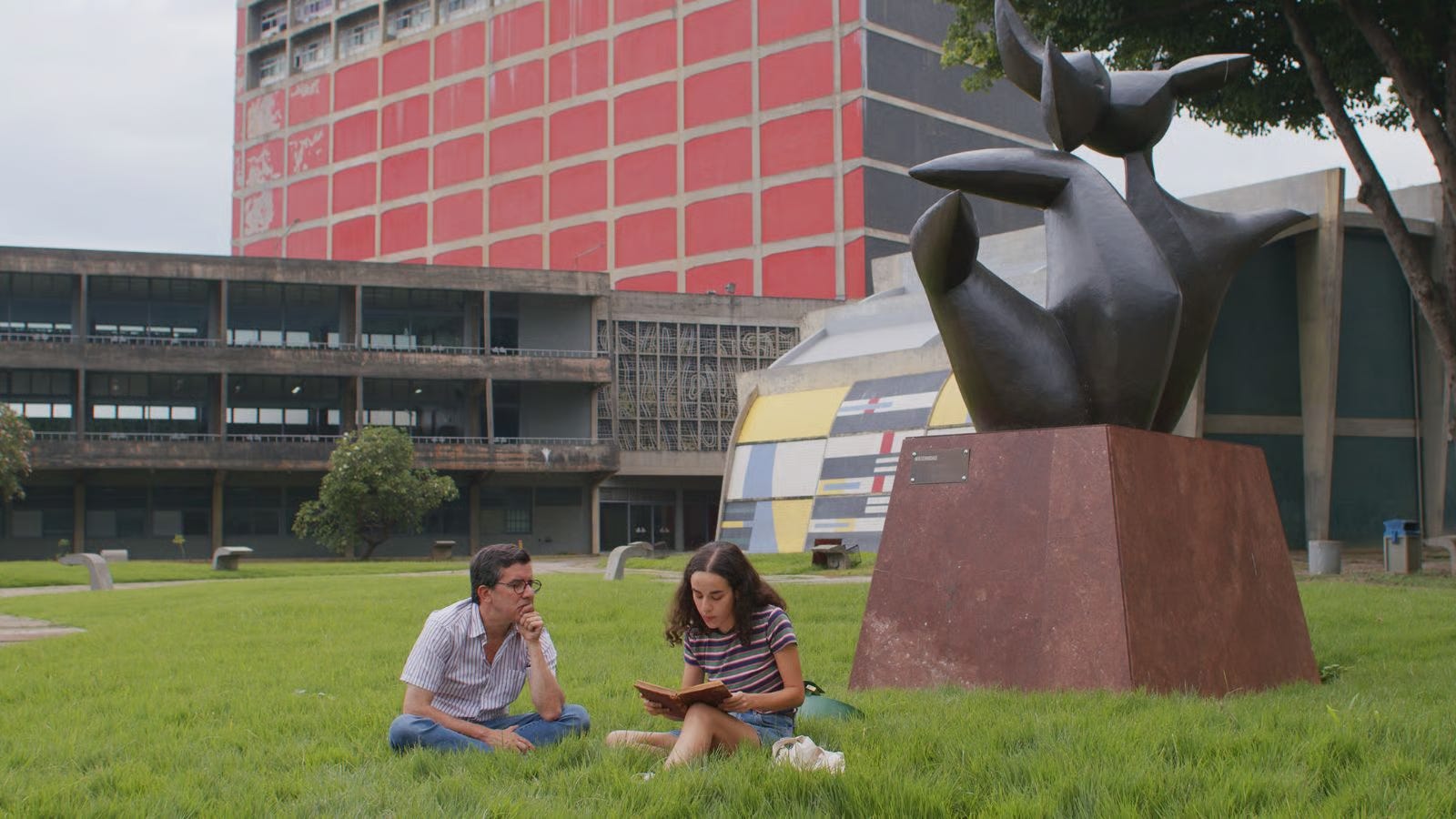
Some films have a way of teaching you how to look and in doing so give you a vivid impression of what the filmmaker values. One such film is Lost Chapters, the debut feature from Lorena Alvarado which premiered at the 2024 Locarno Film Festival and is receiving a run at IFC Center in New York. In this fictional film featuring Alvarado’s real life family members, the inner conflicts of characters are alluded to but seldom brought directly to the fore. What Alvarado focuses not so much on the fraught decisions of day-to-day life, but rather the pleasure of inhabiting a domestic space with loved ones and the joy that comes from creative pursuits. Hints of sadness and regret occasionally drift through the film, but they are often swept up in the placid flow of daily life, whose demands leave little room for self pity.
The film centers upon Ena Alvarado (Lorena’s real-life sister) who visits her father Ignacio (Ignacio Alvarado, Lorena’s father) and her grandmother (Adela Rodríguez, Lorena’s grandmother) to stay at their home in Caracas. Ena is a twenty-five year old woman living abroad and Alvarado withholds information about what her profession is or whether she’s a student. Ignacio is a book dealer who is in the process of planning to open a museum of rare and important Venezuelan books. He closed his previous bookstore and transferred his collection of books to a warehouse. Adela is dealing with memory loss issues (likely attributable to Alzheimer’s or dementia) that sometimes lead her to forget who Ena is. Ena has Adela perform some activities to exercise her mind including looking at old photos and reciting a poem she used to recite when she was younger. When not tending to her grandmother, Ena often helps her father with the maintenance of his book warehouse. One day while shelving books, Ena stumbles onto a postcard with a note that references a book from 1912 called Elvia, written under the name Daniel Rojas. The person who wrote the postcard suspects that Daniel Rojas was the pseudonym of the real-life Venezuelan author Rafael Bolívar Coronado. According to the note, Elvia was one of the first Venezuelan novels to deal with oil. Finding this post-card prompts Ena to conduct research into Coronado and attempt to get to the bottom of the mystery surrounding the author.
Alvarado could have structured the film around the struggles Ignacio and Ena face to take care of Adela, or around the calculations that Ignacio has to make in order to establish the museum. Instead, Alvarado fashions fragments of daily experience into a collage along with the artifacts that fill the family house and the documents that Ena finds while learning about Coronado. This approach makes the film feel like it’s caught in a limbo between the present and the past, with Alvarado faithfully documenting the relics of the house along with the way the weather causes the light conditions in the house to change. In a running motif, Adela straightens paintings and photos that have bent askew, thus giving the impression that the house is alive with movement from the totems of the past. The sad contradiction at the center of the film is that Adela struggles with memory loss despite being surrounded by so many mementos from her family’s history. In an early scene, Ena shows Adela some old photos and Adela’s response to one of them is, “I don’t remember where that is, but I remember I was there.” Ena then reads a sad letter that Adela’s son Francisco wrote long ago and Adela responds by saying she thought Francisco passed away, prompting Ena to inform her that he is living in Chile. Adela exclaims that she wants to give him a phone call and is happy to hear that Ena has his phone number. There is a rhyme to this moment later in the film when Adela is lying in bed with a phone and a list of phone numbers scrawled in a notebook. Through this scene, Alvarado powerfully conveys both Adela’s yearning to be close to her loved ones and the sad implication that this book of numbers might represent Adela’s only means of connection to people she doesn’t fully remember.
Ena’s storyline revolves around her investigation into the history of the author Rafael Bolívar Coronado, which initially involves going with her father to visit bookstores and vendors at open air markets in search of the novel Elvia. These visits generally end in much the same way: the clerk either tells them that he doesn’t have the book or he tells Ena to look through a stack of books. The scenes function more on a documentary level as they provide us with views of Caracas street scenes and of the environs of these quaint bookstores. When Ena starts visiting various archives and libraries to conduct her research, Alvarado cuts betweens shots of Ena looking through documents and closeups of the documents themselves, sometimes intercut with shots of notes that Ena is writing. Alvarado avoids providing an explicit psychological explanation for why Ena is so invested in learning about the life of this mysterious figure. But later in the film, Ena tells her father that she wants to write a historical-fiction novel about the efforts of readers of Coronado to find him. And here we start to learn that there is a parallel between the artistic mission of Ena the character and that of Alvarado the director. Art is obviously an act of creation, but so much of what Alvarado does in the film involves preserving things she finds beautiful in the family house, whether they be the books on the shelves; the sculptures and paintings that decorate the house; the framed photos and photo albums; the foliage out in the yard; and all the strange knick knacks in between. Ena’s excitement upon learning a humorous story about Coronado serving as a war correspondent is the excitement of a burgeoning artist finding a detail they can preserve in their work of art. The film makes you suspect that Alvarado had a similar sense of excitement while going through the historically rich artifacts that she used in the film.
By film’s end, Ena’s bread crumb trail doesn’t lead her to find either a copy of Elvia or some proof that Coronado wrote the novel under a pseudonym. But Alvarado presents no indication that Ena is deterred in her efforts to carry through her passion project, and the film is shot through with her investigative zeal. Rather than situating Ena’s artistic endeavors within the broader context of her life’s goals, Alvarado presents her thrill of discovery as an end unto itself. In fact, how little we know about Ena’s life in general is driven home in the film’s final scene: Ena and her father take a leisurely stroll through an art museum and we learn that Ena’s mother lives in Madrid, leaving us to wonder whether Ena lives there with her. During that scene, Ignacio mentions that he is considering finding a permanent caretaker for Adela. Earlier in the film, there are two scenes (one during the day and one at night) in which Adela leaves the house and goes on a walk without letting anyone know. The day scene ends before we learn how Adela makes her way back and the night scene ends with Ignacio and Ena still in the process of finding her. Given Adela’s memory loss and habit of leaving the house, any other film might take the decision-making surrounding Adela’s care to be the dramatic core of the film. But in Alvarado’s film, the only real indication of how Ignacio wants to handle caretaking comes at the film’s end, through a passing reference to finding a permanent caretaker. Rather than wading more deeply into these issues, the film prefers to dwell on moments of tenderness that register sweetly even as Adela’s memory falters. Hints of darkness linger on the edges of the film, but Alvarado’s overarching goal is to draw out the beauty and quiet majesty of the people and objects she depicts.