

Phantom Beirut
Ghassan Salhab's discursive rendering of civil war era Beirut shows us a picture of an (ex)community in limbo, shaken up by the reappearance of an old comrade
In Phantom Beirut, writer-director Ghassan Salhab situates the film both before and after the end of the Lebanese Civil War, which lasted from 1975 to 1990. The diegetic narrative of the film takes place during the final years of the civil war, at some point in the late 1980s. Salhab alternates between these diegetic scenes and faux-documentary footage from some point after the end of the war that consists of characters speaking to the camera about their perspectives on how the war changed their lives. These jumps between time periods and film styles establish a sense of temporal limbo that conveys the extent to which the characters remain mired in the problems of the past. When an old comrade from the early war days who was presumed to have died returns to Beirut, the characters are thrust back into the unresolved tensions that linger from their time fighting together in the war. The details regarding their involvement in the war remain vague, but the general picture is that the characters were enmeshed in what they once conceived of as a revolutionary struggle. While the idea about what/who they were fighting against remains unclear, Salhab indicates that the characters were previously combatants fighting in the war together and that they feel some regret about the end result of their struggles.
Early in the film, Salhab juxtaposes the tone of a mournful opening with a few humorous scenes of lovers engaging in some waggish banter. We are initially introduced to a character named Hanna (Darina El Joundi) as she talks to the camera about how she lost her sense of purpose after the war ended. Hanna feels more lost and adrift than she did when she was in the midst of a life-or-death struggle during the war. When we first see Hanna in the diegetic scenes of the film, she playfully scolds her boyfriend for sleeping in too much. Over the course of their conversation, we learn that the boyfriend sometimes leaves early in the morning to avoid notice from neighbors. In another scene with a similar tone early in the film a character named Fouad (Hassan Farhat) picks up his girlfriend from the airport. When the girlfriend asks if he’s missed him, Fouad says “a little,” prompting her to call him “a macho.” Salhab leads us to expect that we are about to see a romantic comedy set in a war-torn city. But the appearance of Khalil (Aouni Kawas), an old comrade who disappeared ten years prior and was assumed dead, wrests the film away from the light-hearted focus on present-day romantic issues and into a more solemn reflection on the past. Fouad’s conversation with his girlfriend is interrupted when he sees a man he thinks is Khalil, riding in a taxi riding past Fouad’s car. The news of Khalil’s reappearance ends up making its way to Hanna, who is part of this social group along with Fouad. Fouad later rounds up a few friends to track the man they think is Khalil as he walks out of his hotel, but they get involved in a fender bender before they can confirm it’s him.
The characters who were once comrades of Khalil’s feel a sense of shock and anger when they learn of Khalil’s reappearance. Salhab initially withholds backstory surrounding Khalil’s role in the war and the circumstances relating to his disappearance. In the film’s early scenes, we wonder why the characters feel such a fixity of intense emotion upon learning that Khalil has returned to Beirut. Salhab lets the mystery of Khalil’s prior role in the character’s lives swirl as he introduces the laconic Khalil who moves through the word with an air of detached cool. As Khalil smokes while sitting on a chair in his hotel room, he turns his head and glares out of the window, with Salhab cutting to a shot of clouds twirling in the air. Salhab then undermines this tone of wordless cool by having a maid enter the room, complaining that she hasn’t had the opportunity to clean Khalil’s room. After Khalil urges her out of the room, she accidentally strikes Khalil in the face with the door as she returns to the room to retrieve the bucket she forgot. While the film generally hews to a tone of grave contemplation, Salhab habitually plays against this tone with lighter touches taken from everyday life that continue apace in spite of Beirut’s state of emergency. Before Khalil reunites with Hanna, he stops for a beer at a nearby restaurant. A patron of the restaurant makes a joke about the military barricade outside being erected to “deprive people of the country’s best Foul Mudammas” (a Lebanese stew of fava beans) and waxes philosophical about how the barricades achieve their intended purpose because Lebanese people hate making detours. Salhab uses a variety of methods, including humor and distancing effects, to defuse the tension of a film that generally feels like it’s on the verge of some dramatic revelation or life-altering catastrophe. For the most part, dramatic revelation is often forestalled, and when violence does emerge, Salhab moves past it quickly and doesn’t emphasize the character’s emotional reactions.
In the first scene where Khalil’s former comrades confront him for his perceived betrayal in Hanna’s apartment, Salhab continues to keep certain aspects of Khalil’s role in the war remote from the audience. What Salhab emphasizes is the indignation Khalil’s former comrades feel about him essentially faking his death and escaping Beirut to live in foreign countries. No matter how forcefully these comrades confront Khalil with his transgressions, Khalil maintains an air of emotional detachment, refusing to admit guilt for anything he’s done. Salhab stages the old comrades in dramatic opposition to Khalil, who at times face away from Khalil or turn their bodies away from him even as they throw sideways glances toward him. At one point, Khalil walks away from the other characters and Salhab cuts to a point-of-view shot from Khalil’s perspective that shows a woman on a balcony across the way tending to her collection of plants. When Salhab cuts back to the apartment, he stages the other characters in two rows on either side of the frame with Khalil still facing the window, positioned in the middle of the frame so that the other characters don’t block our view of him. The artificial staging makes this feel like a trial in which the jury has already decided that the suspect is guilty. Rather than cross-examining the suspect to clarify the details of his escape, the judges air their grievances in a scornful manner. Salhab uses the scene less to clarify the character’s past actions and more to stoke the mystery surrounding how Khalil feels regarding his involvement in the war and the effect his disappearance had on his old comrades.
When Hanna and Khalil are left alone in the apartment following the confrontation, Salhab continues to hint at past relations between characters while withholding key details. Hanna invites Khalil to stay in the apartment while he’s in Beirut, mentioning that the apartment is as much Khalil’s as it is hers. This dialogue implies that there might have been some kind of romantic connection between the characters, or merely that Khalil paid for the apartment at some point. Salhab’s refusal to clarify the true nature of their relationship is in keeping with his preference not to more fully explicate the characters’ pasts for the viewer. But this haziness with regard to certain details should not be taken as a sign of narrative slackness on the part of the filmmaker. At all junctures in the film, Salhab provides just enough context regarding the character’s backstory to make the mystery of what kind of emotional and social goals these characters are pursuing compelling. After Hanna invites Khalil to stay at her apartment, she tells Khalil that he should have not returned because his arrival dredged up a past that she and her comrades have tried to forget. Hanna is fine with letting Khalil stay at her apartment, which is her present day action given her current material circumstances. But on a metaphysical level, she holds a grudge with Khalil for coming back from the dead and reminding her of things she wishes she could put behind her. In this way Khalil becomes a kind of symbolic scapegoat for the other characters’ pent-up anger and regret about the problems they have faced during the war. The focus of the film thus becomes the emotional processing that the characters are forced to partake in after Khalil’s reappearance rather than any material obstacles that need to be overcome. Salhab is less concerned with running through the particulars of who did what way back when, and more with evoking the feeling of the past continually impinging upon the present.
While the general approach of the film is discursive and there isn’t a single dramatic focus that the narrative is arranged around, one thread of the film presents the possibility of dramatic escalation. This thread involves the suspicion within the social group that Khalil stole some money from the group’s communal fund before he disappeared. Initially we suspect that this plot will become a structuring focus for the film. At one point, we see Khalil hiding a wad of paper bills behind the headrail of the blinds by the window in his hotel room. Later in the film, as Khalil checks to make sure the cash is still there, he hears a knock at the door that causes him to fall from the chair that he is standing on. He is then confronted by some of his old comrades who press Khalil on whether he stole the cashbox before escaping. Similar to the pattern of the previous confrontation, the comrades’ purported attempts to wrest the truth from Khalil can also be seen as a way of taking out frustrations on Khalil for a broader sense of frustration they have regarding the direction of the war. Once Khalil steps out of the hotel room, one of the old comrades named Youssef (Ahmed Ali Zein) says “You have no idea how little I care about that missing cashbox.” After Youssef and his wife leave the room, a character named Omar (Younes Aoudé) half-heartedly searches around the room before lying down on the room’s bed and closing his eyes. This scene again shows Salhab defusing a dramatic situation and redirecting our attention from the material issue of the missing cashbox to some broader metaphysical issue that is causing Khalil’s former friends to seek some kind of emotional restitution from him. As Youseff’s aforementioned line indicates, it is clear that Khalil’s old comrades are not so much concerned with the money itself than they are in exorcising some demons that Khalil’s reappearance has reawakened in them. The cashbox serves as a macguffin that represents not just Khalil’s perceived betrayal, but the disappointment that they feel about the end result of their struggle within the war.
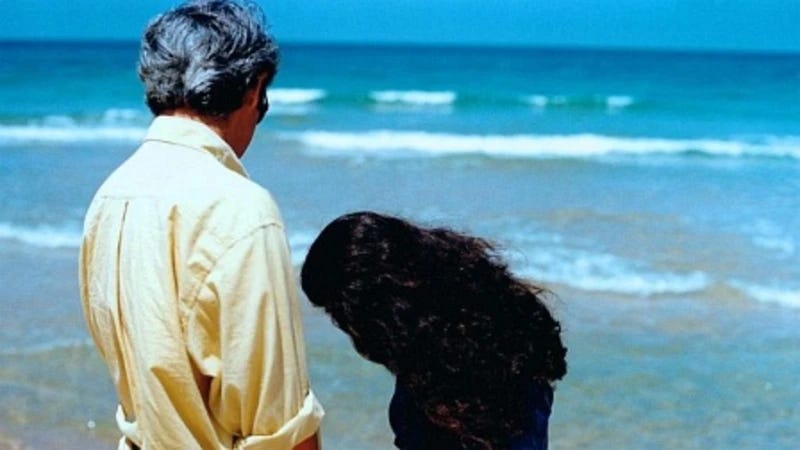
While the reasons for Khalil’s return to Beirut are initially shrouded in mystery, a concrete reason for Khalil’s return to Beirut eventually emerges when he tells an old friend named Ghassan that he wants to reclaim his former identity on his passport. Ghassan appears to be something of a fixer who can secure illicit materials and blackmarket goods for his clients. Over the course of their conversation, we learn that Ghassan is the one who forged Khalil’s documents and gave him a new identity before he escaped. Khalil’s desire to reclaim his real identity has less to do with any legal issues that he might face due to having a fake identity, and more to do with his desire to have his name back and be the same person he was before he became someone else. The audience is left to ascertain that Khalil getting his name back represents something larger than just an officially designated name on a passport. Later in the film, when Khalil and Hanna take a road trip to a nearby shoreline, Khalil reflects on his prior role in the conflict and thinks forward to how he and his fellow Lebanese will react after the war. Khalil implies that he and his compatriots will pretend to forget what happened during the war and “will act like we were irresponsible,” presumably for the plight of Beirut. By giving voice to the desire to escape certain hard truths of the war, Khalil speaks to the emotional instability that he and his social circle seem to endure when they face up to their complicity in the descent of Beirut. Khalil talks about the person he was before his escape and feeling that he is “neither stronger nor wiser” than he was earlier in the war. The retrospective nature of Khalil’s remarks makes it feel as if he’s referring to the ghost of his former self, a self that wasn’t necessarily better situated to take on life’s challenges, but one that at least had some positive illusions about what he and his comrades could achieve for their home nation.
And so I’m brought back to the first piece of faux-documentary footage from after the war that the film presents, which consists of Hanna discussing how she preferred life during wartime. We see other characters of the film speak this way as they talk to the camera about how they have coped with their life during and after the war. You might expect that people who have lived through a brutal and destabilizing war would only say negative things about their traumatic experiences. But Salhab’s film lends the impression that there was an excitement and hope that some of the characters shared when they were in the midst of their battles. In a way, this might make the pain more acute because in addition to the trauma that the characters carry, they also hold onto the broken dreams that they once believed in quite strongly, even as their beloved city was being torn apart. In one of the many faux-documentary segments, Fouad relates some of the positive things he took from the war. He discusses the way that the war allowed him to partake in new experiences such as revolting against his parents and building new kinds of relationships. Part of what makes Phantom Beirut so powerful is its ability to indirectly communicate the strength of the bond these characters once shared. In addition to mourning the state of Beirut, the characters also mourn the death of the promise for a more just future that once united them. Khalil’s return reminds the characters not just of the decay of Beirut, but also of the decay of their once-vibrant community.