

Summer Interlude
Ingmar Bergman is a director whose distinctiveness is never in doubt, no matter how one is inclined to receive his works. There’s a consistency and coherence to his perspective: his unflattering view of human nature, his inclination to allow his characters to pontificate and philosophize, his penchant for drama of the highest degree of intensity and suffering. One almost never detects any amount of wavering from him as he steadfastedly approaches the big topics – morality, spirituality, good and evil – time and time again. I’ve come to appreciate this solidness and immutability from him more and more over time, despite having started out with a fairly stubborn resistance to his sensibility and personality. He still strikes me as a bit melodramatic and at times condescending when he lets his most sadistic tendencies run wild, but at least you feel that his existentialism is sincerely held, that he protects the independence of his thought against any and all temptation to dilution.
Summer Interlude is the first Bergman I’ve seen in possibly almost a decade, and I was surprised how much fondness sprung up in me towards him as I sunk into the familiar tone and vibe of the film. Maybe it’s a bit of nostalgia toward the early days of my cinephilia, the chasing after classics, high art, deep themes, with Bergman acting as representative of the kind of personality one might mythologize during one’s intellectual development. Things that used to bother me about him (and they still bother me a bit, to be frank) became somewhat bemusing to track – his leaning toward theatrically grotesque characterizations, for example, particularly exemplified here by the gross (non blood-related) “uncle” groomer character Farbror Erland (Georg Funkquist). For all the pontifical content that makes up his films, the effects he likes to derive are rather blunt and sensorial, intended largely to provoke direct, instinctual reactions of repulsion or attraction. It’s automatic that he will, in a pinch, go to the darkly lit, unflatteringly wide-angle close-up if it’s someone you’re supposed to dislike, using flesh and sweat to make his point for him; conversely, if it’s a good thing or good person, the light softens, the world opens for them in an idyllic glow, like it does for the star-crossed lovers Marie (Maj-Britt Nilsson) and Henrik (Birger Malmsten) at the heart of this film. This perhaps gives his films a harshness that amplifies the moralism that his projects always have a greater or lesser degree of at their core.
Summer Interlude is not among his best works, and I don’t feel that he had much in the way of grand ambitions for it. The story is simple and sentimental and feels crafted for the viewership of its time with its lost-love melodramatics ensconced within the nostalgic flashback structure. His direction is steady and technically sound, but you can only feel Bergman being Bergman in the interstitial moments and in the longer conversational scenes – wherever he feels comfortable inserting some incongruous philosophizing, to be precise – because the twists and turns of the actual plot don’t hold up much under scrutiny. Credit to Bergman, however, that he finds a way to maximize the amount of angst that we are able to feel through Marie before the paper-thin excuse of a narrative starts to get worn down. The opening of the film is purposefully vague as the delivery of a package (later revealed to be the dead boyfriend’s diary) plunges our prima ballerina protagonist Marie into a ruminatory mood, setting her dark mental state in contrast to the elite display of artful grace that is the ballet. Bergman rides this mood through the entire first act as she shrugs off her current lover David (Alf Kjellin) and heads to the shack on the isle where she and Henrik had their rendezvous.
Thence begin the flashbacks, and with them the moody mystery of the film dissipates considerably. Perhaps it’s because I didn’t find Biger Malmsten a particularly compelling actor, but as soon as the tale of their happy bygone days started unspooling before me, the film gradually lost its compellingly emo energy and became rather too mundane by Bergman standards. Henrik is just not a particularly compelling character, even if one argues that the portrayal is idealized on purpose due to it coming from Marie’s own memories. Their happy-go-lucky summer romance is a collection of clichés that would probably get clipped into a highlight reel of “dead wife” moments these days, with the gender reversed of course. Running along the beaches, splashing water everywhere, soft morning glow and wild strawberries to be eaten… The only thing complicating this section of the film is the mystery of what happened to Henrik in the end – how he ended up out of the picture in the present day. Strong suggestions that Erland, the creepy “uncle,” was a big factor in the implied tragic development ultimately turn out to be half-true; and the film dangles an inheritance from Henrik’s aunt as a potential red herring as well, implying the possibility that Henrik murdered her.
While it’s a bit of cleverness that neither of these dark developments occurred, I’m not sure Bergman could be bothered to make the actual reason for Henrik’s death (swimming accident) dramatically compelling. He really doesn’t make much of it at all, so that it seems a bit perfunctory and takes out some of the air from Marie’s resentful mood. By making the cause of death an accident, he also has to work overtime to justify Marie’s hatred of Erland, making it unrelated to Henrik and purely due to his taking advantage of her in the emotional aftermath of the loss. In terms of character psychology, this seemed to drive the film into near incoherency in its final stretch, deflating the seriousness and consistency of Marie’s emotional plight by framing the events in the past as just a nice memory randomly cut short; the vagueness of the post-accident years add to this feeling of irresolution, as if the filmmakers just threw up their hands and gave up on tying up any of the loose ends.
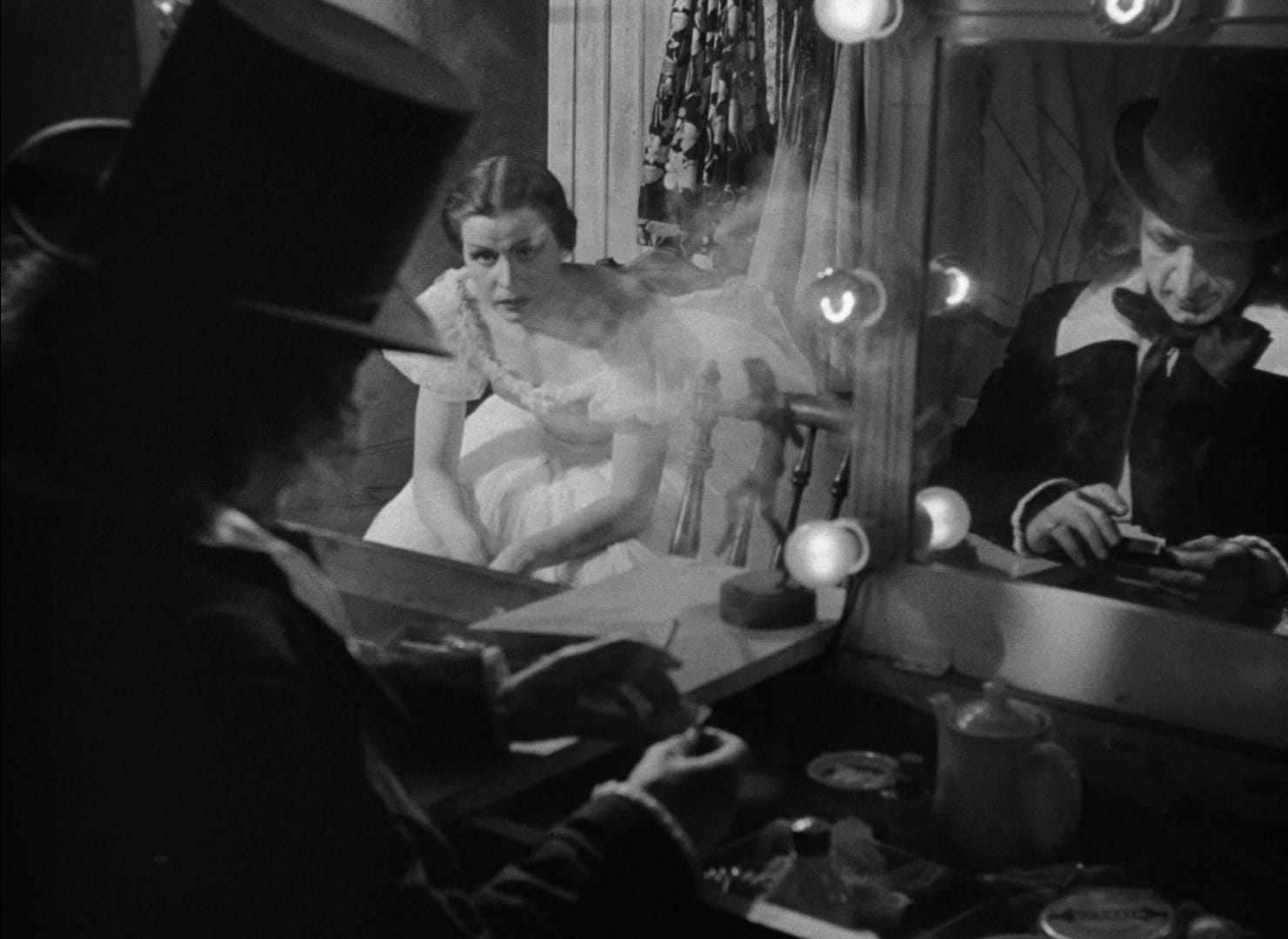
Still, it wouldn’t be Bergman without a macho existential homily to wrap things up. The final scene in the dressing room, with the ballet master in his clown-face showing up to sternly lecture Marie on the lofty anxieties of being true to oneself, are classic Bergman, for better or worse. This sort of ex cathedra self-insertion is a real staple of Bergman’s work, and whereas in prior years I might’ve been more resistant to its heavyhandedness and its strident reclamation of a pretty fluffy sentimental piece for philosophical purposes, at this point in my cinephilia I kinda almost admire the chutzpah and sheer unselfconscious drive that Bergman has for getting his thoughts and beliefs onto the screen by whatever means necessary. I wouldn’t go so far as to say I like that he does this – there are surely more artful ways to arrive at discourse without breaking the bond of fiction – but his purpose as an artist is clear, and he isn’t the least bit ashamed of it, which has to count for something. As the canon ebbs and flows and film history continues to revise itself, I can now see Bergman coming back into the vogue in a moment where we get tired of cowardice in the arts, whereas I used to see him fading out of view. Wincing at his excesses though I will continue to do, I’m surprisingly more than ever open to revisiting the old classics to ride the vibe of his confidence and candor.