

The Bride!
Despite some fringe benefits, Maggie Gyllenhaal's The Bride! remains uninspiring and facile in its depiction of social resistance
Sometimes when I’m watching a contemporary Hollywood film and it becomes clear that the film lacks a coherent personal vision, I go searching for elements of the film to engage myself with. I may look for aspects of the production design that I find striking; maybe I’ll try to focus on moments of performance that appeal more than the general drift of the film’s sensibility; at times I’ll reflect on how the film either plays into or subverts narrative conventions. Basically I try to find ways to make the process of watching this film productive when I realize that the film as a whole is not going to come together in a satisfying way. I used to find it harder to sit through films I didn’t like, but now I kind of see it as a mental exercise that can be enjoyable in its own right and can also help me develop my ideas about what makes films good or bad.
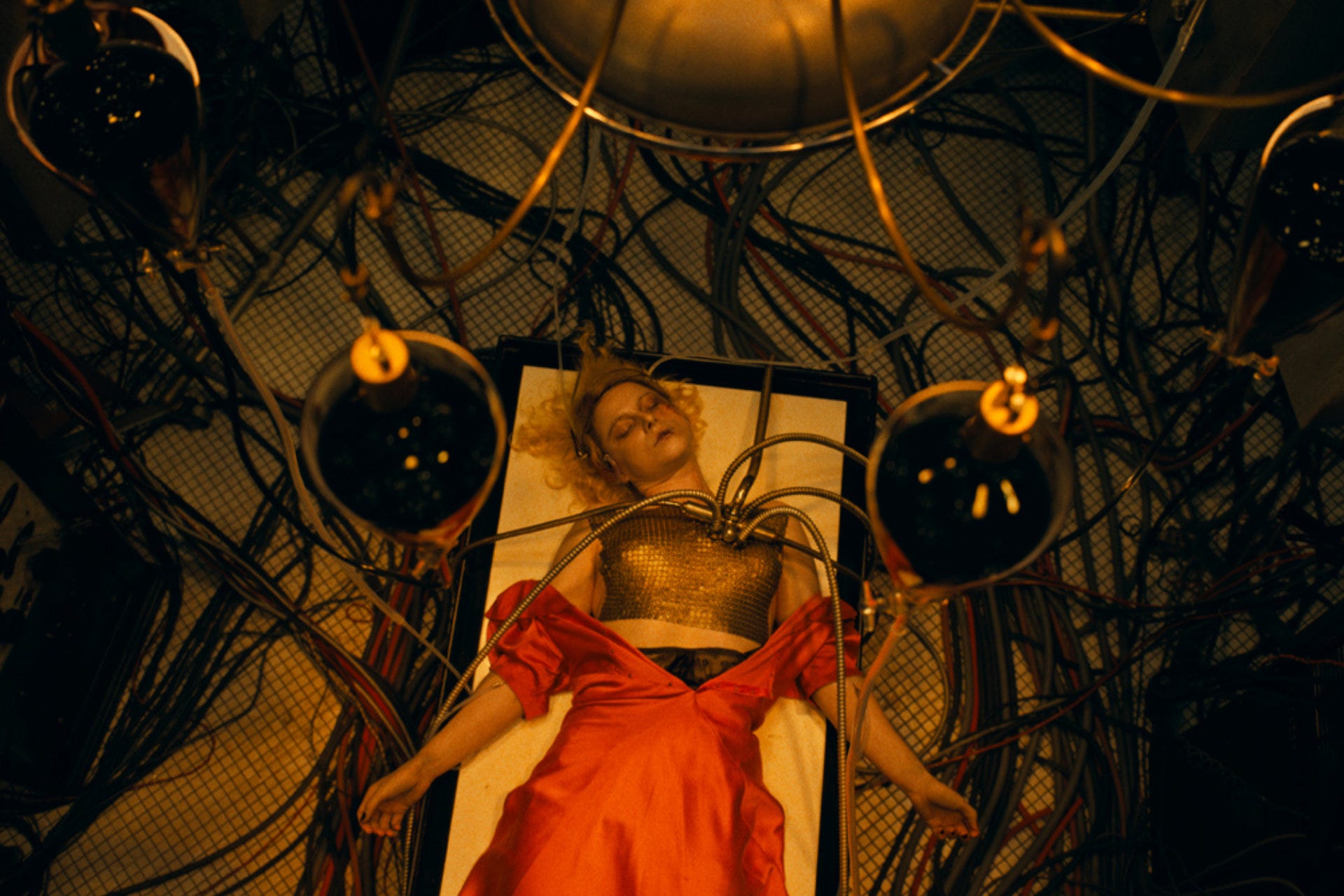
This is all to say, I got the impression pretty early on that The Bride!, the new riff on The Bride of Frankenstein narrative that was written and directed by Maggie Gyllenhaal, would not be much to my liking. When Mary Shelley herself (played by Jessie Buckley, who also stars as Ida, the titular bride of the film) opens the film by giving a lugubriously silly mission statement as to why she wants to bring her story surrounding the bride of Frankenstein to life, I groaned internally, wondering what I’d gotten myself into. Eventually we are introduced to Ida, the future titular bride, who is hanging out at a restaurant with some men who we end up learning are part of a mob ring. She is harassed by one of the mob members before having what appears to be some kind of breakdown, causing the restaurant as a whole to quiet down as she shouts in an unhinged manner. As she’s taken into a room with a stairwell, two mob members forcefully try to quiet her down and eventually Ida slips down the stairs and dies in what could either have been considered an accident or a deliberate shove from one of the mob members. The film then whisks us away to show us Frankenstein’s monster, referred to as Frank (Christian Bale), who asks a scientist named Doctor Euphonious (Annette Benning) to provide him with a bride. Euphronious ends up using an electrical reanimation to bring Ida’s corpse back to life. After some awkward moments between Frank and Ida as they get to know each other (Frank’s lonely monster status has made him socially ill-adjusted), they eventually develop a rapport and a romance. When two men start harassing Frank and Ida after they go to a speakeasy, Frank kills the two men, leading the rest of the film to become a “lovers on the run” parable, as Frank and Ida try to evade both the cops and the mob members Ida palled around with in her past life.
In a running thread of the film that’s established early on, Ida goes on florid rants in a British accent that feature many multi-syllabic words that don’t come together to make a whole lot of sense. Even as these kinds of rants proceeded over the course of the film, I never really understood how we as the audience were supposed to take them. Are we supposed to find them impressive and witty? Are we supposed to be troubled by the rants as a hysterical response to trauma? Are they merely the literary pretensions of Mary Shelley coming out of Ida’s mouth in an incoherent manner? Divorced from some kind of clear context for why Ida kept ranting and raving like this, I landed on the idea that Gyllenhaal just found these stream of conscious monologues to be cool and rebellious. When directors try to present a character’s behavior as a jolt of direct pleasure, I find that the character needs to be uniquely appealing to make that work. I personally did not find Ida’s defiant stance all that interesting, so a lot of that speechifying and irreverence just fell flat for me. In an early scene after Ida’s reanimation, Ida sits down with Euphonious and Frankenstein for breakfast and starts nudging plates of food and cups off the table. When Euphronious asks Ida to stop doing that, Ida responds by quoting “Bartleby the Scrivener” and saying “I would prefer not to.” When Euphronious says Ida is quoting Hawthorne, Ida smugly responds by saying she’s quoting Melville. I think this moment speaks to the facile way we’re supposed to be charmed both by Ida’s refusal to conform to social etiquette norms and by her pretensions to literary expression (Frank is impressed by the big words Ida uses and I think Gyllenhaal intends for the audience to enjoy her poetic flights of fancy).
For me, this gets to the problem with the film at large – I don’t think Gyllenhaal’s directorial stance regarding Ida’s rebellion was all that complicated or thoughtful. After a series of murders that she and Frank carry out, the couple become a media sensation. Women around the country start dressing up like Ida and performing actions called “brain attacks” (that’s taken verbatim from the film) where they confront men at gunpoint as acts of revenge. The film as a whole posits Ida’s rebellious behavior as a response to a cycle of abuse from male attackers. I’m generally not sure how seriously we are supposed to take the social movement that arises due to Ida and Frank’s acts of violence. But in general, Gyllenhaal seems to revel a bit uncritically in all these acts of retribution as a form of feminist reprisal against the patriarchy. I am not necessarily pearl-clutching about this and I can accept that violent revenge is the name of the game for a film about aggression towards male oppression. Nevertheless, I was looking for nuance surrounding the depiction of Frank and Ida’s retribution that showed some degree of reflection or circumspection from Ida and Frank about what their life has become in the wake of these murders and the cultural sensation they have inspired. Without that nuance, we’re just kind of left to root for these Bonnie and Clyde-like lovers on the run to overcome their pursuers. And while Gyllenhaal captures the delirious impulsivity of their love kind of nicely, the narrative dynamic of the chase and pursuit of our heroes starts to feel one-dimensional.
Which brings me to the rumination that I included in this first paragraph. When it became clear that I didn’t like where the film was going, I went in search of elements that I could appreciate. I enjoyed the art direction and costuming of the scene in which Ida and Frank go to the speak-easy, which involves some combination of 1930s era period-accurate attire and other apparel that suggests something more fantasy/horror-oriented. A few of the recreations of old Hollywood musicals were somewhat endearing, with Jake Gyllenhaal as film star Ronnie Reed doing an intentionally hackneyed impression of an old Hollywood film star. I was somewhat charmed by the way Maggie Gyllenhaal plays the “lovers on the run” scenario in a sincere register. There were no obligatory stumbling blocks to the romance, even as Frank revealed that he lied to Ida about their being married before Ida’s accident. This romance is indicative of the film’s broader joie de vivre, which also comes across through the film’s enthusiasm regarding the arts in general and the source material in particular. At certain movie screenings that Frank and Ida characters attend, the film onscreen morphs to show Frank and Ida acting out their current situation in the film’s narrative at that point.
But ultimately, The Bride! does not really have a guiding principle for all its allusions, intertextuality and fourth wall-breaking. The film exhibits a frantic and slipshod energy that is characteristic of a work of narrative art that doesn’t really know what it wants to be. Gyllenhaal’s wide range of influences and aspirations don’t cohere because the film’s sense of dramatic logic doesn’t unify all the disparate elements. And at the end of the day, the rebellious streak that could have tied the film together just feels pretty lame and uninspiring. It was nice to see a Hollywood film with this level of artistic ambition, but the film asks us to buy into a facile conception of social resistance and I wasn’t having it.